Our Technologies
An electrical process and a chemical one.
We work with two treatment methods that handle heavy metals and difficult industrial wastewater consistently well. Often we use them together — electrocoagulation for the bulk reduction, SME chemistry for polishing or for waste streams the E-Cell can't fully handle alone.
Powell Water E-Cell
Electrocoagulation.
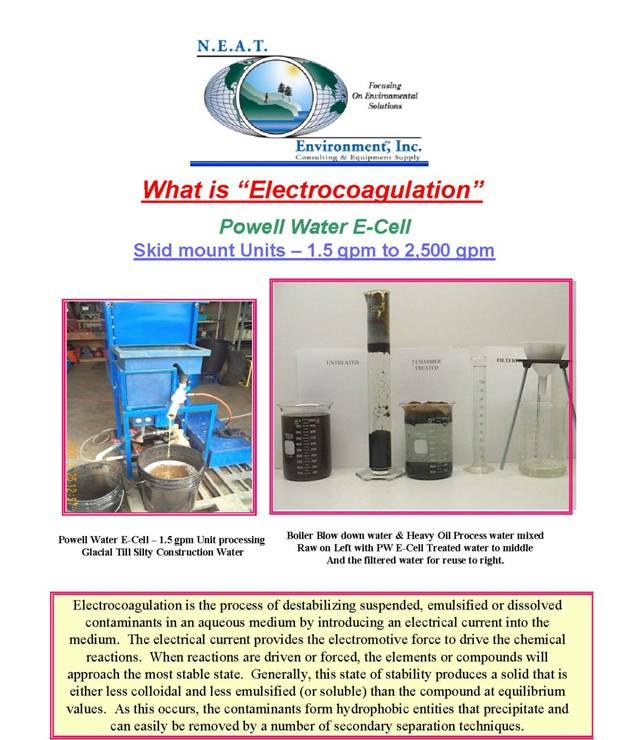
Pass an electrical current through contaminated water and the contaminants destabilize. Suspended, emulsified, or dissolved metals form oxide sludge that filters out cleanly and passes leach tests.
How it works
Electrocoagulation introduces electrons into solution by passing alternating or direct current through the water from the power grid. The electrons destabilize the suspended, emulsified, or dissolved material in the water. When sufficient activation energy is present, the destabilized contaminants form an oxide sludge.
That oxide sludge repels water, filters well, and dewaters cleanly — without the bogging problem that polymer-treated sewage sludges create in landfills.
Heavy-metal ions converted to metal oxides pass the standard leach tests, which means the resulting waste is non-hazardous. The metals can be recovered and smelted back into usable form if volumes warrant it.
What it handles
The E-Cell is broadly capable: electroplating rinse water, hard chrome stripper tanks, radiator wash water, glacial-till silty construction water, SAGD heavy-oil process water, boiler blow-down, food processing plant effluent, dairy digester sludge, and stormwater runoff.
In numbers
Why it's cost-effective
Compare against the alternatives. Reverse osmosis produces concentrated reject water that contains all the heavy metals you started with — just in a smaller volume, and now harder to dispose of. Ion exchange requires continual maintenance of the exchange resin; regeneration costs typically run about half the capital cost annually. Evaporation works but the energy cost runs about $0.15 per gallon.
The E-Cell capital cost is comparable to ion exchange and substantially less than evaporation. Operating cost is the lowest of the four options — often by an order of magnitude.
What you get out
Two outputs: clean water suitable for reuse in your process (or discharge to municipal sewer within regulation), and an oxide sludge that filters cleanly and disposes as non-hazardous waste.
For shops aiming at zero discharge, the treated water gets recycled back to rinse tanks. For shops aiming at compliance with discharge limits, the treated water meets municipal sewer standards.
NAC-6 / KB-1
Silica micro-encapsulation.
The "Best Available Technology" for heavy-metal contaminated water, soil, sediment, and sludge. Where polymer treatments degrade over time, the SME silica matrix continues to strengthen.
The chemistry
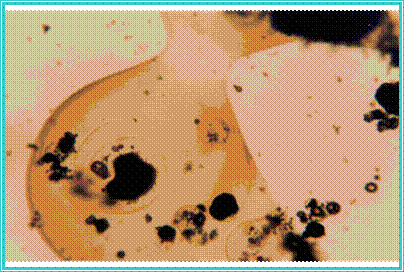
SME (Silica Micro Encapsulation) usually achieves control of contaminants in a single step — without pretreatment chemicals or post-treatment flocculation or filtration. Its physical and chemical components include an initial exothermic reaction and pH adjustment, followed by an electrokinetic reaction and metal hydroxyl formation that leads to silica encapsulation.
The entire reactivity and stabilization process happens in minutes and generates harmless sand-like sediments that rapidly settle out of the water. Treated water concentrations of heavy metals are reduced well below state, federal, and provincial pollution criteria — often below detectable limits.
Unlike conventional polymer-based treatments that lose effectiveness over time, the SME silica matrix continues to tighten, further isolating contaminants from the environment.
What it handles
NAC-6 / KB-1 is a robust technology, demonstrated to work effectively on heavy metals including chromium, copper, lead, mercury, and zinc; on metalloids such as arsenic; and on radionuclides such as uranium. It applies equally to wastewater, sediment, sludge, soil, mine tailings, and other complex media.
Cr, Cu, Pb, Hg, Zn
The full range of plating-shop and shop-floor contaminants — chromium (both Cr⁶⁺ and Cr³⁺), copper, lead, mercury, zinc.
Arsenic
Mining drainage, smelter byproducts, and historic site contamination where arsenic is the primary concern.
Uranium & daughters
Encapsulation of uranium and decay products in stable silica matrix for safe long-term disposal.
Regulatory advantages
For shops carrying a Ministry of Environment "Special Waste" designation, moving to NAC-6 treatment typically reclassifies the operation to "Industrial Waste" — which has substantial downstream effects.
No Special Waste Permit
Generally not required for business operation once the waste stream is reclassified.
Reduced premiums
Usually no Special Waste insurance required; reduction in general business operations insurance.
No director-level liability
Generally no director or personal Special Waste designated liability remains attached to the operation.
$200/tonne vs $1,100/tonne
NAC-6 treated sludge disposes as non-hazardous: approximately $200/tonne. Hazardous waste sludge: approximately $1,100/tonne.
NA-6 product at no extra cost
Compared to the untreated cost of sludge disposal, NA-6 chemistry is effectively free — the disposal savings cover it.
Continuous discharge compliance
Treated water meets municipal sewer discharge standards on a continuous basis, not just spot tests.
Combined Treatment
Often we use both.
The two technologies aren't competitors. For most industrial shops the right answer combines them — the E-Cell does the bulk reduction work on the main waste stream, and KB-1 SME chemistry handles polishing or specific contaminants the E-Cell isn't optimized for.
This is particularly true for chromate and hard chrome shops, where Cr⁶⁺ needs to be reduced to Cr³⁺ before either treatment can fully encapsulate it. We typically use sodium meta-bisulfite for the reduction step, then E-Cell or KB-1 (or both) for the final treatment.
The full process design depends on what's in your water, what regulatory limits you're meeting, and whether you're aiming for compliance, recycling, or zero discharge. We sort that out during the treatability study.
Treatability Study
Not sure if it'll work?
Send us a sample.
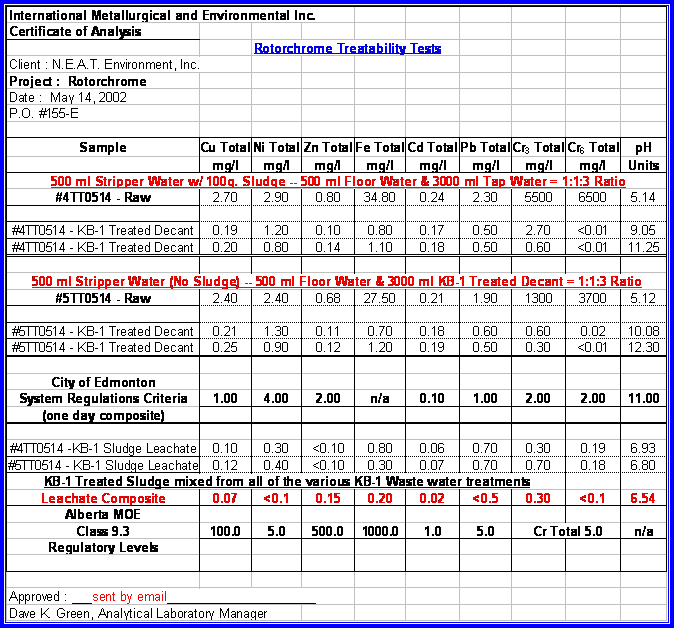
For most industrial wastewater problems, the only way to know what treatment works is to run a treatability study. We do this regularly — small bench-scale tests in our shop, with independent lab analysis.
- Phone
- (250) 717-7866
- info@neatenvironment.com
- Location
- Ponoka, Alberta · Canada