Case Study · Hard Chrome
Rotorchrome: stripper tank Cr⁶⁺ at 6,500 mg/L to under regulation.
Dual bench treatability tests (#4TT0514 and #5TT0514) on mixed stripper-tank and floor-waste process water from an Alberta hard chrome facility. Two-step Cr⁶⁺ reduction followed by KB-1 silica encapsulation. Treated water and sludge leachate both pass City of Edmonton sewer discharge and Alberta MOE Class 9.3 landfill standards.
The samples
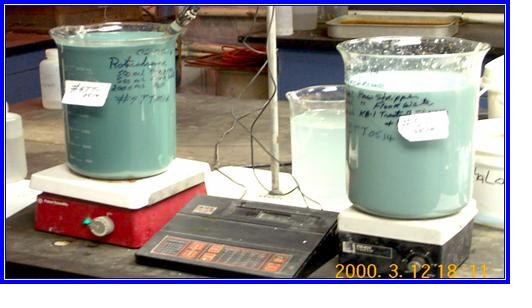
Two parallel bench tests were set up using waste water from the stripper tank and floor sump at a hard chrome facility in Alberta. The mixed-source samples were chosen to represent the realistic loading the shop's treatment system would see in normal operation.
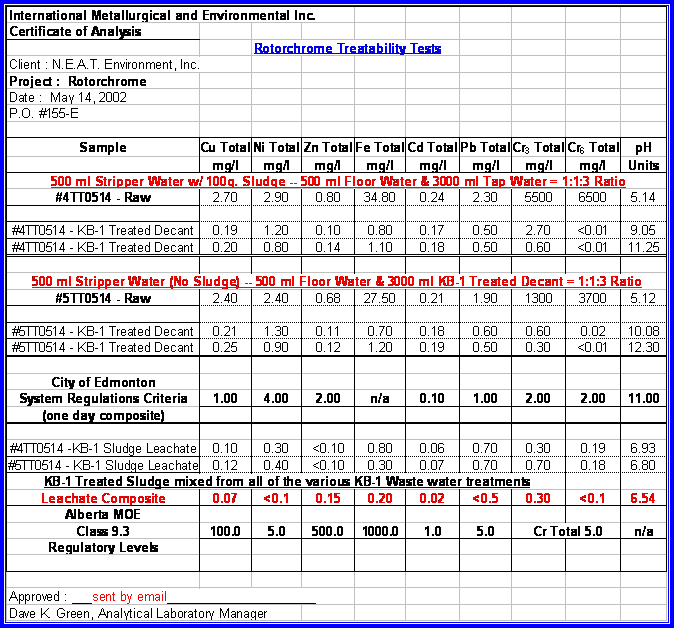
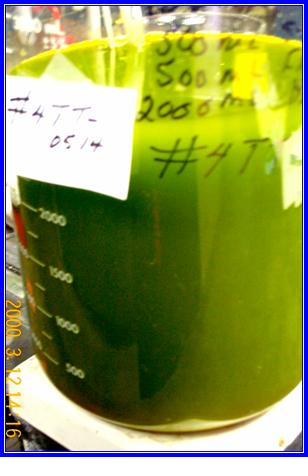
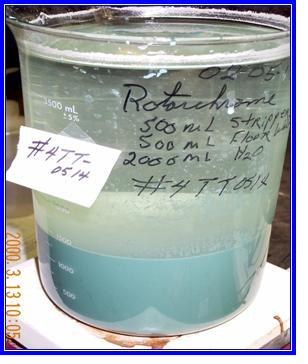
Beaker #4TT0514 mixed 500 mL of raw stripper waste water with 100 g of sludge, 500 mL of floor waste water (no sludge), and 3,000 mL of tap water — a 1:3 ratio of contaminated to dilution water. The high sludge loading pushed chromium concentrations to 5,500 mg/L Cr³⁺ and 6,500 mg/L Cr⁶⁺ in the test mixture.
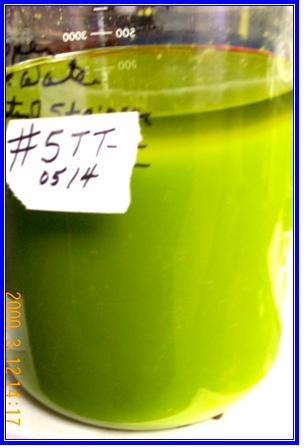
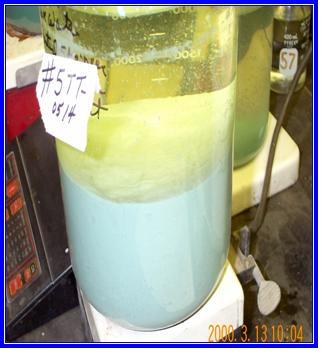
Beaker #5TT0514 used the same mix ratio but without sludge, and with previously KB-1-treated decant water as the diluent instead of tap water. Chromium concentrations in this test were correspondingly lower since no sludge contribution was present.
The treatment
Hard chrome waste requires a two-stage treatment because most of the chromium is in the highly oxidized Cr⁶⁺ (hexavalent) state, which silica encapsulation chemistry cannot directly stabilize. The first stage uses sodium meta-bisulfite to chemically reduce Cr⁶⁺ to Cr³⁺ (trivalent), at which point the second stage of KB-1 treatment can encapsulate it into the silica matrix.
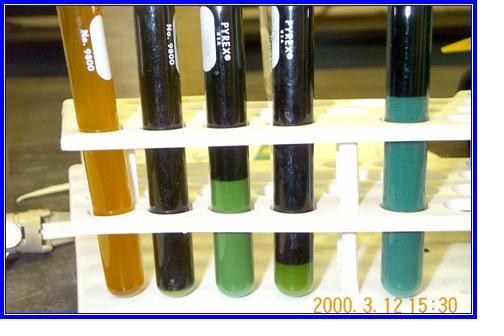
The colour change during the Cr⁶⁺ reduction stage provides a clear visual indicator of the reaction's progress — from yellow-orange (Cr⁶⁺) through olive green to a dark blue-green (Cr³⁺). Once the colour change is complete, KB-1 is added in stages with continuous agitation.
Results
IME's certificate of analysis confirmed both Cr⁶⁺ and Cr³⁺ concentrations dropped below detection limits in the treated water from both test beakers. Treated water meets the City of Edmonton sewage discharge standards on every regulated parameter.
The composite sludge — a mixture of all sludge generated from this and subsequent treatment runs — was tested for heavy-metal leaching under the Alberta MOE Class 9.3 Leachate Method. Results showed the treated sludge meets MOE landfill leachate standards, meaning the waste can be disposed in a regular landfill rather than as hazardous waste.
For a hard chrome operation, the disposal-cost differential between hazardous and non-hazardous classification is substantial — roughly $1,100 per tonne vs $200 per tonne — and the operational simplification of no longer needing Special Waste permits, insurance, or director-level liability typically pays for the treatment chemistry many times over.