Case Study · Stormwater
Redmond, WA: full-scale batch SME stormwater system.
A full-scale batch treatment system for removing turbidity and heavy metals from stormwater, developed by Keeco with Aero Construction Company. The system operated on a trial basis under extensive review by Washington state and City of Redmond officials — including water quality monitoring and bioassay testing. Pending state approval as a Best Management Practice for stormwater treatment.
Overview
Keeco, in conjunction with Aero Construction Company, developed a batch treatment system for removing turbidity and heavy metals from stormwater using Silica Micro Encapsulation (SME) technology. A full-scale treatment system operating on a trial basis underwent extensive review and testing by Washington state and City of Redmond officials, including water quality monitoring and bioassay testing. The technology is pending state approval as a Best Management Practice for treating stormwater runoff.
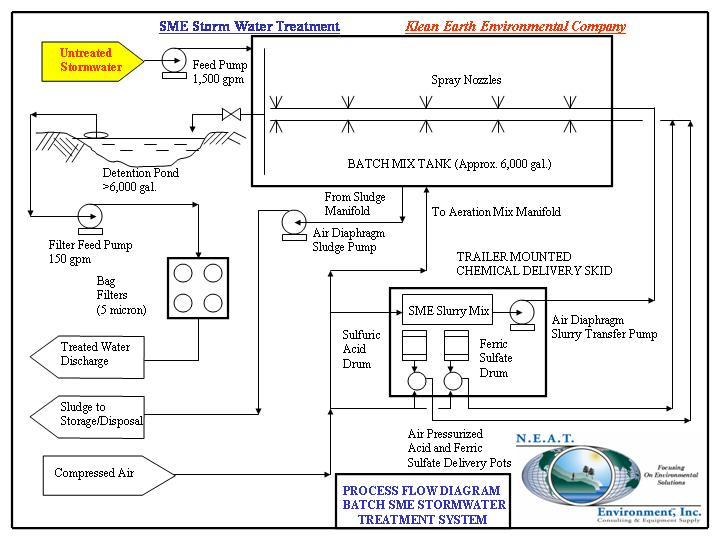
The batch SME treatment system is designed to process stormwater at a minimum effective flow rate of 100 gpm. The system as designed does not include polymer addition; bench-scale tests indicate polymer addition could reduce clarification time enough to support 150 gpm effective rate or higher. The system design can be modified for multiple units of the same size or scaled up. While demonstrated on stormwater, the same system is equally effective on dredge water.
Process Description
Step 1 — Fill
Stormwater is pumped from a holding area into the Batch Mix Tank by the Feed Pump at approximately 1,500 gpm. At this rate, the Batch Mix Tank fills in about 5 minutes. Compressed air piped into a distribution header at the bottom of the tank — with valves on each segment for even distribution — provides thorough mixing of water and treatment chemicals.
Step 2 — Ferric Sulfate Pretreatment
Approximately 10.6 litres of a dilute 3% ferric sulfate solution (0.56 gallons of ferric sulfate per 1,000 gallons of water treated) is gravity-drained from the Ferric Sulfate Drum into the Ferric Sulfate Air Pressurized Delivery Pot. A calibrated sight glass measures the dispensed volume. The delivery pot is then pressurized with compressed air and the discharge valve is opened, transferring the solution through a flexible hose to a spray nozzle header above the Batch Mix Tank for even distribution. The ferric sulfate adds an iron seed that enhances precipitation and clarification.
Step 3 — pH Adjustment
Approximately 7.5 litres of 33% sulfuric acid (0.4 gallons of acid per 1,000 gallons of water treated) is dispensed from the Sulfuric Acid Drum into a similar Pressurized Delivery Pot and transferred to the Batch Mix Tank through the spray header. The acid drives the pH down into the working range for SME chemistry to function.
Step 4 — SME Treatment
The NAC-6 / KB-1 silica chemistry is then introduced, encapsulating heavy metals and turbidity-causing particles into a sand-like sediment that settles cleanly within the Batch Mix Tank.
Step 5 — Clarification & Discharge
After mixing, the system holds the water for the clarification period required for the silica matrix to settle. Treated clear water is decanted to discharge; settled sludge is pumped to a sludge holding tank for dewatering and disposal.
Regulatory Status
The Washington State Department of Ecology and the City of Redmond performed extensive review including water quality monitoring and bioassay testing on the discharge from the trial installation. The technology is pending state approval as a Best Management Practice (BMP) for stormwater treatment — once approved, the system can be specified directly by engineers and contractors on stormwater compliance projects without per-installation regulatory review.
Applications
The system applies to stormwater runoff from construction sites, industrial yards, and contaminated land — anywhere turbidity and heavy metals need to be removed before discharge to surface water or municipal storm sewer. The same system also handles dredge water from waterway maintenance operations.