Case Study · Radiator Repair
ORL Radiator: dark gray waste at pH 5.17 to clear water.
Bench treatability study on wash and process water from a radiator repair shop — a typical mixed-metals waste stream with copper, lead, zinc, aluminum, and phosphate loading, plus a hydrocarbon sheen and a substantial odor. KB-1 single-step treatment, IME Labs analysis.
The sample
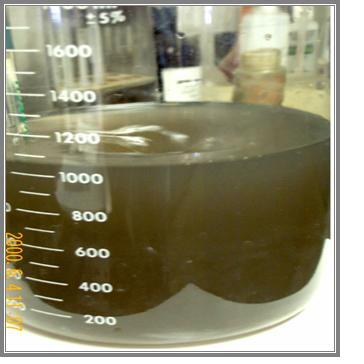
Initial waste wash and process water was collected by Ken Gardner of N.E.A.T. Environment and transported to International Metallurgical & Environmental's (IME) laboratory for raw water analysis. Raw water was dark blackish-gray with organic solids floating on the surface, a light hydrocarbon sheen, and an extremely bad odor — typical for a radiator shop that processes both wash water and test tank water in the same waste stream.
When given an hour to settle, only limited particulate dropped to the bottom of the beaker — the bulk of the contamination was dissolved or suspended in a way that wouldn't separate gravitationally. Initial pH was 5.17.
The treatment
The pH was first adjusted from 5.17 down to 4.05 using 3 mg of HCl acid, with magnetic stirring throughout. As pH approached 4.00 the water colour remained the same but a light floc began to form and the heavy odor subsided slightly — an indication that volatile sulfur compounds were precipitating out with the floc.
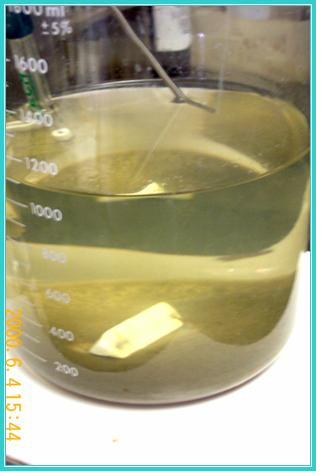
With pH stable at 4.05, KB-1 was introduced in two stages of 0.5 grams each, mixed into 25 mL of tap water as a slurry before being added under continuous stirring. The first addition brought pH to 4.74; the second addition brought it to a stable working pH where the silica encapsulation reaction completes.
Results
Treated water analysis by IME Labs confirmed copper, lead, zinc, and aluminum concentrations all dropped to levels below municipal discharge limits. The treated sludge passes leach testing for non-hazardous disposal.
For radiator repair shops, this approach is particularly useful because the mixed-source waste stream — wash water plus test tank water plus floor sump — combines into one treatment loop without requiring source segregation. A small shop can treat its full daily volume in a single batch.