Case Study · Electroplating
Joe's Plating: 800 gal/day to 60 gal/month.
A specialty metal plater facing continual scrutiny from the city sanitation district eliminated daily wastewater discharge by installing a 3 gpm Powell Water E-Cell. Rinse water is now recycled. Operating cost: $0.002 per gallon.
The shop
Joe's Plating is a specialty metal plating operation in Santa Barbara, California — the kind of small-to-medium shop that handles short-run custom work for industrial customers. The shop's plating process generated roughly 800 gallons of contaminated rinse water per day, all of which had to be trucked off site for hazardous waste disposal.
That created two related problems. First, the city sanitation district was monitoring the shop closely — any incidental discharge would have created compliance trouble. Second, the per-gallon cost of trucked disposal was significant, and growing as regulations tightened.
The installation
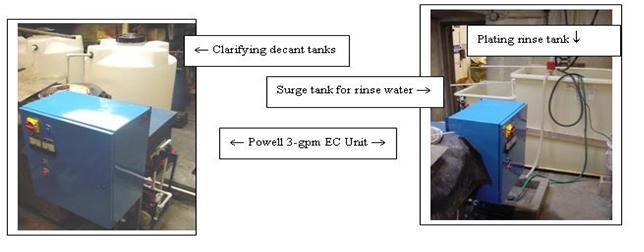
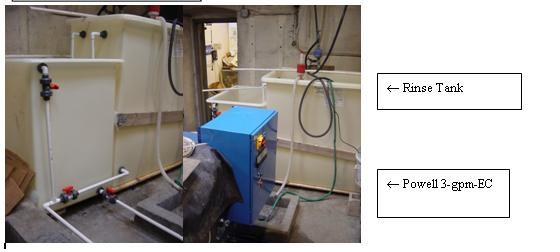
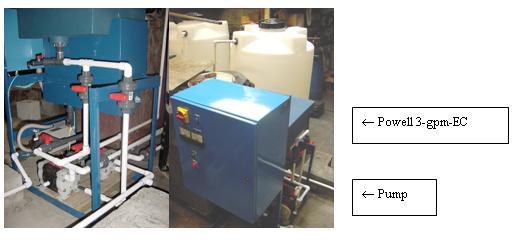
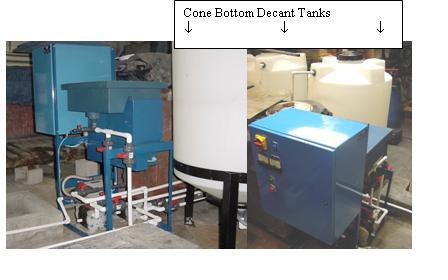
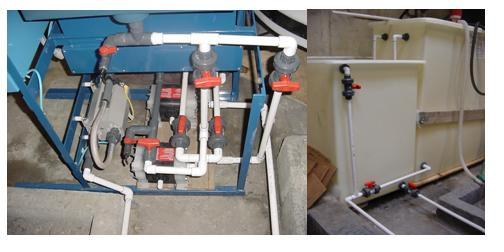
In 2001, Joe's Plating installed a 3 gpm Powell Water E-Cell, configured as a closed-loop recycling system rather than as a treatment-and-discharge system. Contaminated rinse water from the plating line flows to the E-Cell; treated water returns to the rinse tanks for reuse.
The configuration eliminates the discharge stream entirely. Sludge generated by the E-Cell is collected, dewatered, and disposed as non-hazardous waste — at a fraction of the cost of the previous trucked liquid waste disposal.
Results
The shop received a zero-discharge permit shortly after commissioning the E-Cell. Average residual discharge dropped to under 2 gallons per day — effectively, the small volume of evaporation makeup needed in the rinse tanks. The city sanitation district has had no compliance issues with the shop since installation.
Operating cost on the E-Cell is approximately $0.002 per gallon — about $1.60 per day at the shop's typical flow. That compares with the prior trucked waste disposal cost of several dollars per gallon. Capital cost for the E-Cell was recovered in well under two years.
Takeaway
The Joe's Plating installation has been operating continuously since 2001 with minimal maintenance — the typical pattern for E-Cell installations. For specialty plating shops facing increasing discharge restrictions, closed-loop electrocoagulation is often the most cost-effective path to a zero-discharge operation.
We've replicated similar installations at electroplating, hard chrome, and radiator repair shops across Western Canada and the western United States, with similar economic and regulatory outcomes.