PROCESS
DESCRIPTION
BATCH SME STORMWATER AND CONSTRUCTION WATER TREATMENT SYSTEM
NEAT and Keeco, in
development of the Canadian Marketing and Project Servicing Alliance, are
offering the SME Keeco “Silt Settlement”
Stormwater and Construction Water Treatment process and
treatment systems to our clients. The
following will describe the process and trial testing that has been completed
to date. Please call us for further
information and project estimates.
Overview
KEECO, in conjunction with Aero Construction Company, has
developed a batch treatment system for removing turbidity and heavy metals in
stormwater using the Silica Micro Encapsulation (SME) technology. A full-scale treatment system operating on
a trial basis has undergone extensive review and testing by Washington
state and City of Redmond
officials, including water quality monitoring and bioassay testing. The technology is currently pending approval
by the State as a Best Management Practice for treating stormwater runoff.
The following process description applies to the batch
system that has been constructed and tested.
The batch SME treatment system has been designed to process stormwater
at a minimum effective flow rate of 100 gpm.
The system, as designed, does not include polymer addition to enhance
settling. Based upon bench-scale tests,
it is estimated that polymers could reduce clarification time to allow for an effective process flow rate of 150 gpm or
more. The system design can be modified
to include multiple units of the same size or scaled up to increase treatment
capacity. Alternately, a continuous flow
system could be designed for more permanent installations. Although this system has been demonstrated on
stormwater, it should be equally effective on the treatment of water generated
from dredging operations.
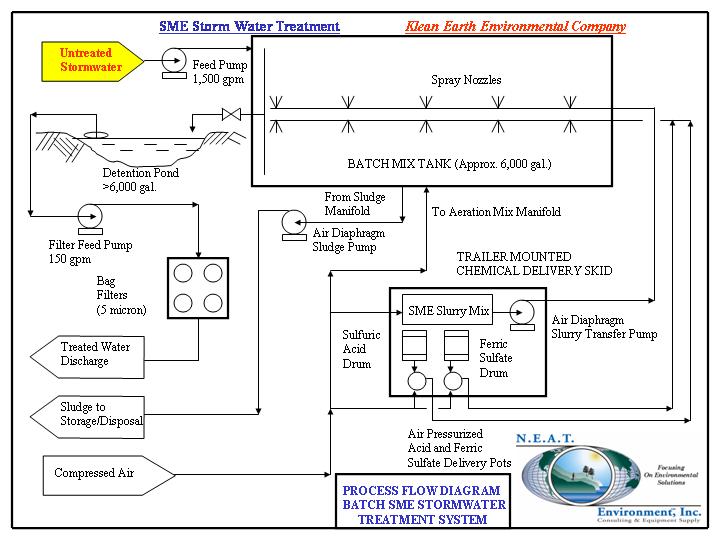
Process Description
Stormwater is pumped from a
holding area into the Batch Mix Tank with the Feed Pump at an approximate rate
of 1,500 gpm. At this rate, the Batch
Mix Tank can be filled in about 5 minutes.
Compressed air, piped into a distribution header in the bottom of the
Batch Mix Tank, is regulated using valves located on each segment of the
distribution header to provide even and thorough mixing of the water and
treatment chemicals.
Approximately
10.6 liters of a dilute 3 percent ferric sulfate solution (0.56 gal ferric
sulfate per 1,000 gallons water treated) are gravity drained from the Ferric
Sulfate Drum to the Ferric Sulfate Air Pressurized Delivery Pot. A calibrated sight glass is affixed to the
delivery pot to measure the dispensed volume of ferric sulfate. The delivery pot valving is then reversed to
allow compressed air
to
pressurize the pot.
Page 2.0 Keeco/NEAT
SME Silt Settlement Process N.E.A.T.
Environment, Inc.
Process Description…..
Continued
The discharge valve is then
opened, thereby transferring the solution through a flexible hose to a spray
nozzle header located directly above the open top of the Batch Mix Tank for
even distribution. Ferric sulfate pretreatment
adds an iron seed that enhances the precipitation and clarification
process. Approximately 7.5 liters of 33
percent sulfuric acid (0.4gal acid per 1,000 gallons water treated) are then
dispensed from the Sulfuric Acid Drum into the Sulfuric Acid Air Pressurized
Delivery Pot and transferred to the Batch Mix Tank in the same manner as the
ferric sulfate through the same distribution header. Through bench-scale testing, it was
determined that sulfuric acid, added in an amount to provide a pH of
approximately 2.85 to 3.0, results in the most effective treatment in
conjunction with the SME slurry.
Sulfuric acid requirements may vary depending upon the initial pH and
buffering capacity of the water to be treated.
The ferric sulfate and acid are allowed to mix for a couple of minutes
until fairly uniform pH values are measured in the tank using a portable
handheld pH probe.
A dilute slurry of the SME reagent
META-LOCK (approximately 6.25 lbs. to 20gallons water) is made up in the SME
Slurry Mix Tank using either fresh water or treated stormwater. This usage rate equates to approximately
1.25 pounds of META-LOCK per 1,000 gallons of water treated. The slurry is mixed in the Slurry Mix Tank
via compressed air supplied to a distribution header. The SME slurry is then pumped into the Batch
Mix Tank with the air diaphragm Slurry Transfer Pump through a spray nozzle
header adjacent to the ferric sulfate/acid delivery header. The tank is allowed to mix for several
minutes until a fairly uniform pH is observed using a portable handheld pH
probe. The target pH range is 6.5 to
8.5. Additional META-LOCK slurry may be
added as a final adjustment to pH if required. Valving to the Batch Mix Tank
air mix header is shut off and the coagulated particulates (floc) are allowed
to settle for approximately 30 minutes.
After 30 minutes, the
majority of the floc is settled to the bottom of the Batch Mix Tank. Treated clarified water is then drained from
the tank to the Detention Pond via a floating suction header to within about 8 to
12 inches of the tank bottom. The 6-inch
gravity discharge line provides a high rate of flow averaging about 750 gpm,
draining the tank in about 7 minutes.
The total processing time for one batch is approximately 45 minutes.
The Batch Mix Tank is then
refilled and the process repeated. While
this takes place, the water in the Detention Pond is discharged, pumping the
water with the Filter Feed Pump through one train of the 5-micron Bag Filters
to the selected discharge location. The
Bag Filters serve as a backup to ensure that excess solids are not discharged.
The solids collected in the
Batch Mix tank are allowed to remain in the tank for successive treatments as
solids recycle improve the floc settling characteristics. When the sludge height builds up to
approximately 6 inches, the sludge is pumped off to within about 2 inches of
the bottom via the Sludge Pump that is connected to the sludge collection
manifold in the tank bottom. The sludge
can be temporarily stored in a small portable holding tank or disposed of
either onsite or off site.